FOLLOW ME!!

**********I'm blogging at MichellePendergrass.com and Visual Prayer now!**********
Showing posts with label FIRST. Show all posts

Thursday, May 1, 2008

May FIRST--Finding Hollywood Nobody

I get excited when the book we're highlighting is someone I know. Lisa and I have just started a friendship a few months ago. The more I'm around this amazing woman, the more I love her (and her family!!) I haven't read this book yet mostly because I've got a stack of others by her I'm getting caught up on, but knowing what I know, there shouldn't be any disappointment!

So while we're out of town, enjoy this FIRST chapter.



It is May FIRST, time for the FIRST Blog Tour! (Join our alliance! Click the button!) The FIRST day of every month we will feature an author and his/her latest book's FIRST chapter!


Today's feature author is:


and her book:


Finding Hollywood Nobody


Navpress Publishing Group (February 15, 2008)


ABOUT THE AUTHOR:

Lisa Samson is the author of twenty books, including the Christy Award-winning Songbird. Apples of Gold was her first novel for teens

These days, she's working on Quaker Summer, volunteering at Kentucky Refugee Ministries, raising children and trying to be supportive of a husband in seminary. (Trying . . . some days she's downright awful. It's a good thing he's such a fabulous cook!) She can tell you one thing, it's never dull around there.

Other Novels by Lisa:

Hollywood Nobody, Straight Up, Club Sandwich, Songbird, Tiger Lillie, The Church Ladies, Women's Intuition: A Novel, Songbird, The Living End

Visit her at her website.

AND NOW...THE FIRST CHAPTER:


Chapter One

Hollywood Nobody: Sunday, June 4

Well, Nobodies, it's a wrap! Jeremy's latest film, yet another remake of The Great Gatsby, now titled Green Light, has shipped out from location and will be going into postproduction. Look for it next spring in theaters. It may just be his most widely distributed film yet with Annette Bening on board. Toledo Island will never be the same after that wacky bunch filled in their shores.

Today's Hottie Watch: Seth Haas has moved to Hollywood. An obscure film he did in college, Catching Regina's Heels (a five-star film in my opinion), was mentioned on the Today show last week. He was interviewed on NPR's Fresh Air. Hmm. Could it be he'll receive the widespread acclaim he deserves before the release of Green Light? For his sake and the film's, I hope so.

Rehab Alert: I've never hidden the fact that I don't care for bratty actress Karissa Bonano, but she just checked into rehab for a cocaine addiction. Her maternal grandfather, Doug Fairmore, famous in the forties for swashbuckling and digging up clues, made a public statement declaring the Royal Family of Hollywood was "indeed throwing all of our love, support, and prayers behind Karissa." The man must be a thousand years old by now. This isn't Ms. Bonano's first stint in rehab, but let's hope it's her last. Even I'm not too catty to wish her well in this battle. But I'm as skeptical as the next person. In Hollywood, rehab is mostly just a fad.

Today's Quote: "It's a scientific fact. For every year a person lives in Hollywood, they lose two points of their IQ." Truman Capote

Today's Rant: SWAG, or Party Favors. Folks, do you ever wonder what's inside those SWAG bags the stars get? Items which, if sold, could feed a third-world country for a week! And have you noticed how the people who can afford to buy this stuff seem to get it for free? I'm just sayin'. So here's my idea, stars: Refuse to take these high-priced bags o' stuff and gently suggest the advertisers give to a charitable organization on behalf of the movie, the stars, the whoever. Like you need another cell phone.

Today's Kudo: Violette Dillinger will be appearing on the MTV Video Music Awards in August. She told Hollywood Nobody she's going to prove to this crowd you can be young, elegant, decent, and still rock out. Go Violette!

Summer calls. Later!

Monday, September 15, 4:00 a.m.

Maybe I'm looking for the wrong thing in a parent.

I turn over in bed at the insistence of Charley's forefinger poking me in the shoulder. "Please tell me you've MapQuested this jaunt, Charley."

She shakes her tousled head, silhouetted by the yellow light emanating from the RV's bathroom. "You're kidding me right?" She slides off the dinette seat. Charley's been overflowing with relief since she told me the truth about our life: that she's not really my mother, but my grandmother, that somebody's chasing us for way too good of a reason, that my life isn't as boring as I thought. We're still being chased, but Charley can at least breathe more freely in her home on the road now that I know the truth.

Home in this case happens to be a brand-spanking-new Trailmaster RV, a huge step forward from the ancient Travco we used to have, the ancient Travco with a rainbow Charley spread in bright colors over its nose.

"Where to?" Having set my vintage cat glasses, love 'em, on my nose, I scramble my hair into its signature ponytail: messy, curly, and frightening. I can so picture myself in the Thriller video.

"Marshall, Texas."

"East Texas?"

"I guess."

"It is." I shake my head. Charley. I love her, I really do, but when it comes to geography, despite the fact that we've traveled all over the country going to her gigs ever since I can remember, she's about as intelligent as a bottle of mustard. And boy do I know a lot about bottles of mustard. But that was my last adventure.

"If you knew, then why did you ask?" She flips the left side of her long, blonde hair, straighter than Russell Crowe, over her shoulder. Charley's beautiful. Silvery blonde (she uses a cheap rinse to cover up the gray), thin (she's vegan), and a little airy (she's frightened of a lot and tries not to think about anything else that may scare her), she wears all sorts of embroidered vests and large skirts and painted blue jeans. And they're all the real deal, because Charley's an environmentalist and wouldn't dream of buying something she didn't need when what she's got is wearing perfectly well. She calls my penchant for vintage clothing "recycling," and I don't disagree.

"Is this really a gig, Charley, or are we escaping again?"

She shakes her head. "No phone call. I really do have a job."

I feel the thrill of fear inside me, though there's no need right now. Biker Guy almost got me back on Toledo Island. (Yeah, he looks like a grizzled old biker.) To call the guy rough around the edges would be like saying Pam Anderson has had "a little work done."

I've been looking over my shoulder ever since.

But more on that later. We need to get on the road. And I need to get on with my life. I'm so sick of thinking about how things aren't nearly what I'd like them to be.

I mean, do you ever get tired of hearing yourself complain?

I flip up my laptop, log on to the satellite Internet I installed (yes, I am that geeky) and Google directions to Marshall, Texas, from where we are in Theta, Tennessee—actually, on the farm of one of Charley's old art-school friends who gave her some work in advertising for the summer. Charley's a food stylist, which means she makes food look good for the camera. Still cameras, motion picture cameras, video, it doesn't matter. Charley can do it all.

"Oh, we've got plenty of time, Charley. Five hundred and fifty miles and . . . we have to go through Memphis . . ."

My verbal drop-off is a dead giveaway.

"Oh, no, Scotty, we're not going to Graceland again."

The kitsch that is Graceland speaks to me. What can I say?

And you've got to admit, it's starting to look vintage. Now ten years ago . . .

I cross my arms. "Do you have cooking to do on the way?"

Yes, highly illegal to cook in a rolling camper.

"Yeah, I do."

"And do you expect me, an unlicensed sixteen-year-old, to drive?" Again, highly illegal, but Charley's a free spirit. However, she refuses to copy CDs and DVDs, so in that regard, she's more moral than most people. I guess it evens up in the end.

"Uh-huh."

"Then I think I deserve a trip through the Jungle Room."

She rolls her eyes, reaches down to the floor, and throws me my robe. "Oh, all right. Just don't take too long."

"I'll try. So." I look at the screen. "65 to route 40 west. Let's hit it. And we'll have time to stop for breakfast."

Charley shakes her head and plops down on the tan dinette bench. The interior of this whole RV is a nice sandy tan with botanical accents. Tasteful and so much better than the old Travco that looked like a cross between a genie's bottle and the Unabomber cabin. "You're going to eat cheese. Aren't you?"

"I sure am."

And Charley can't say anything, because months ago she told me this was a decision I could make on my own.

Freedom!

"I've rethought the cheese moratorium, baby. I know you're not going to like this, but three months of cheese is enough. I can't imagine what your arteries look like. I think it's time to stop."

"What?" Cheese is my life. "Charley! You can't do this to me."

"It's for your own good."

"Are you serious?"

"Yeah, I am."

"Why?"

"Because summer's over, baby, and we've got to get back to a better way of life."

I could continue to argue, but it won't do any good. Charley acts all hippie and egalitarian, but when push comes to shove, she's the boss. However, I'm great at hiding my cheese . . . and . . . I'm going to convince her eventually.

But still.

"This isn't right, Charley, and you know it. But it's too early to argue. And might I add, you have no idea what it's like to have a teen with real teen issues. You ought to be on your knees thanking God I'm not drinking, smoking, pregnant, or"—I was going to say sneaking out at night, but I've done that, just to get some space—"or writing suicidal poetry on the Internet!"

We stare at each other, then burst into laughter.

"Just humor me this time, baby," she says. "We'll come back to it soon, I promise."

I don't believe her, but I hop into the driver's seat, pull up the brake, throw the TrailMama into drive, and we are off.

Six hours later

I pull through Graceland's gatehouse at ten a.m., park near the back of the compound's cracked, tired parking lot, and change into some crazy seventies striped bell-bottoms, a poet shirt, and Charley's old crocheted, granny-square vest. Normally I go further back in my vintage-wear, but I'm trying to go with the groove that is Graceland.

I kiss Charley's cheek. "I'll be back by noon."

"When will that put us in Marshall?"

"By six thirty."

"Because I'm not sure where the shoot is."

"Please. Marshall's small. Jeremy and company will make a big splash no matter where they set up. Besides, growing up around this, I have a nose for it."

She awards me one of her big smiles. "You're somethin', baby. I forget that sometimes." She puts her arms around me, squeezes, pulls back, then smacks me lightly on my behind. "Tell Elvis I said hello."

"Oh, I will. He's one of the groundskeepers now, you know."

I've seen computer-generated pictures of what he would look like now, in his seventies. Scary.

I jump down from the RV, head across the parking lot, over the small bridge leading into the ticketing complex and walk by Elvis's jets, including the Lisa Marie. Gotta love anything with that name. Don't know why. Just has a nice ring to it.

Banners proclaim, "Elvis Is."

Is what? Dead? A legend? What? Because he isn't "izzing" as far as I'm concerned. Present tense, people! If the person's not alive, "is" can only be followed by a few options: Buried up in the memorial garden. Rotting in his casket. Missed by his family and friends. Not exactly banner copy, mind you.

Still, you've got to admit the name Elvis wreaks of cool. Perhaps the sign should read, "Elvis Is . . . A Really Cool Name."

But it's not nearly as cool as my name. You see, my real mother loved the writer F. Scott Fitzgerald. And that's my name: Francis Scott Fitzgerald Dawn. Only Dawn's not my actual last name. I don't know what my real last name is. My real first name is Ariana. Being on the run, Charley renamed us to protect our identity. So she honored my mother by naming me after Mom's favorite novelist. More on that later too.

It sounds fun, traveling on the road from film shoot to film shoot, never settling down in one place for too long, but honestly, it's very sad.

I always knew Charley lived with a sadness down deep, and when I found out why this spring, her sadness became mine. See, my dad is dead and my mother, Charley's daughter Babette, is too. Or we think she must be, because she disappeared under questionable circumstances and never came back. Learn that when you're fifteen and see where you land.

When I thought Charley was my mother, I had such high hopes for who my father might be. Al Pacino was number one in the ranking. Don't ask.

Okay, Elvis, here we go. Let's you and me be "taking care of business."

I hand over my money to the lady behind the reservations counter. I called thirty minutes ago on my cell phone, compliments of my mother's friend Jeremy, and reserved a spot.

"You'll be on the first tour."

Yes! More time amid the shag carpeting and the gold records. And the jumpsuits. Can't forget the jumpsuits. I want a cape too.

The gift shop calls to me. Confession: I love gift shops. They even smell sparkly. Key chains dangling, saying, "You can take me with you wherever you go!" Mugs with the Saint Louis Gateway Arch or the Grand Ole Opry promising an even better cup of coffee. Earrings that advertise you've been somewhere. That's exactly what I choose while I wait for the tour, a little pair of dangly red guitars with the words Elvis Presley in gold script on the bodies, and how in the world they put that on so small is beyond me. See, gift shops can even be miraculous if you take your time and look.

A voice over the loudspeaker announces my tour number, so I stand in line. By myself. Just me in a group of twenty or so.

Okay, here is where it gets hard to be me. I know I should be thankful for my free-spirited life. But especially now that I know my parents are dead, it feels empty all of a sudden. I shouldn't be standing in line at Graceland alone. My mother and I should be giggling behind our hands at the man nearby who's actually grown a glorious pair o' mutton-chop sideburns, slicked back his salt-and-pepper curls, and shrugged his broad shoulders into a leather jacket. Really, right? My father, who was an FBI agent the mob shot right in a warehouse in Baltimore, would shake his head like a dad in a sixties TV show and laugh at his girls.

We'd get on the bus like I'm doing now, each of us putting on our tour headphones and hanging the little blue recorders around our necks in anticipation of the glory that is Elvis.

The driver welcomes us as he shuts the hydraulic doors of the little tour bus with its clean blue upholstery, a bus in which an assisted-living home might haul its residents to the mall.

It smells new in here, and my gross-out antennae aren't vibrating in the least like they do when I go into an old burger joint and the orange melamine booth hasn't been scrubbed since the place opened in 1987.

In my fantasy, my dad would sit beside me. And Mom, just across the aisle, holding onto the seatback in front of her, would look at me as we pass through those famed musical gates, because she would have introduced me to Elvis music. According to Charley, my vintage sentimentalism comes from my mom. I've learned a little about her this summer.

Charley said, "She'd wear my cousin's old poodle skirt and listen to Love Me Tender over and over again while writing in her diary." She became a respected journalist, loved books as much as I do. I pat my book in my backpack, looking forward to tonight when I can cuddle into my loft and get into one of Fitzgerald's glittering worlds. "She was different from me, Scotty. I tried to change the world through protest. Your mother wanted to build something completely different and much better." She sighed. "All my generation could do, I guess, was tear apart. It's going to take our children to put the pieces back together. Babette was a very careful person. Very purposeful."

If it drove my freewheeling grandmother crazy, she doesn't let on.

"I could try to describe how much she loved you, baby. But I don't think I could begin to do her devotion to you justice. I was so proud of her, for how much she loved and gave away. She was amazing."

So in May I found out she existed, the same day I found out she is dead, or most likely dead. And now I'm going into Graceland alone, truly an orphan. Who wants to be an orphan?

We disembark from the bus—me, Elvis Lite, some folks from a Spanish-speaking country, and a lot of older people. I miss Grammie and Grampie right now. More later on them, too. And you'll get to meet them. Like the waters of the Gulf Stream, we seem to travel in the same general direction. I spent a week with them this summer in Tennessee. Yeah, we did Nashville right. They're loaded.

Standing beneath the front porch, my gaze skates up and down the soaring white pillars and comes to rest on the stone lions that guard the steps. My father was a lion. That's why he ended up with a bullet in his chest. Speaking in very broad terms, the story goes as follows:

Dad, undercover, worked his way into a portion of the mob, or mafia if you prefer, that was heavily financing the campaign of a Maryland gubernatorial candidate. When they discovered him, they shot him on site, in a warehouse in the Canton neighborhood of downtown Baltimore. My mother watched, gasped, and a chase ensued. She hid in a friend's gallery, called Charley and told her to keep watching me. (Charley had kept me the night before because my mom and dad had some glamorous function to attend.) And then she disappeared.

The Graceland tour recorder tells me to look to my right into the beautiful white living room with peacock stained-glass windows leading into the music room. This room really isn't so bad, I've got to admit. A picture of Elvis's dad hangs on the wall. He really loved his parents.

I've toured this house at least seven times before, and I'll tell you this, Elvis's love for his family soaked into the walls. A girl that lives in a camper, has dead parents, and is being chased by someone from the mob who knows my grandmother knows what went down, well, she can feel these things.

Charley thinks someone's trying to kill us. This guy is always trying to find us, but Charley's really great at evasion. She said the politician who won the governor's seat all those years ago just announced his candidacy for president and—oh, GREAT!—he's probably trying to make sure nothing comes back to haunt him and sent Biker Guy to finish off the entire matter.

The thing is, he seems to be after me too. And what in the world would I have to do with all of that?

I'll bet Charley's back in that camper shaking in her shoes because I'm over here by myself; I'll bet she's figuring out more ways to be utterly and overly protective of me. I wouldn't be surprised if she's wondering whether locking a kid in an RV is child abuse.

But I love Charley. I really do. I know she's scared back there, and despite the fact that I would be no real help if Biker Guy caught us, I can't leave her there so frightened and alone for long.

Elvis dear, I can only stay a little while. So love me tender, love me sweet, and for the sake of all that's decent, don't step on my blue suede shoes.

I hurry past the bedroom of Elvis's parents, decorated in shades of ivory and purple, very nice, and through the dining room—a little seventies tackiness I'll admit—into the kitchen with dark brown cabinetry and the ghosts of a million grilled peanut butter and banana sandwiches, then on down into the basement. Okay, I admit, I've got to just stand for a second in the TV room and admire the man's ability to watch three TVs at once on that huge yellow couch with the sparkly pillows.

I shoot through the billiard room, which is, honestly, truly beautiful with its fabric-lined walls and ceiling, up the back steps and into the Jungle Room, probably Graceland's most famous room. Green shag carpet overlays the floor and the ceiling, and heavily carved, Polynesian-style furniture is arranged around a rock-wall waterfall at the end of the room. It really defies the imagination, folks. Google Jungle Room Graceland and see what I mean.

The second floor of Graceland is closed off to the public because Elvis died up there. On the toilet. Wise decision on the part of Priscilla I'd say.

Out the door, into the office building, down to the trophy hall, I whiz through all the gold and platinum records, the costumes, the awards, and even a wall full of checks he'd written for charity. According to my recorder, Elvis was an active community member in Memphis. And he obviously didn't care what race or religion people were. He supported Jewish organizations, Catholic, Baptist. Pretty cool.

Of course, this recorder isn't going to tell of the dark side of the man. But Elvis Isn't, despite what the banners say. So why drag a dead man through the mud?

I hurry through the racquetball court, more gold records, the infamous jumpsuits, back outside to the pool and memorial garden where Elvis has been laid to rest.

An older lady cries into a handkerchief. I don't ask why.

Good-bye Elvis. Thanks for the tour. Maybe one day I'll do something great too.

A few minutes later . . .

Tuesday, April 1, 2008

April FIRST


It is April FIRST--no foolin'--, time for the FIRST Day Blog Tour! (Join our alliance! Click the button!) The FIRST day of every month we will feature an author and his/her latest book's FIRST chapter!


The feature author is: Eric Reinhold and his book:
Ryann Watters and the King's Sword

Read the first chapter here!

Saturday, March 15, 2008

Saturday, March 1, 2008

March FIRST


It is March FIRST, time for the FIRST Day Blog Tour! (Join our alliance! Click the button!) The FIRST day of every month we will feature an author and his/her latest book's FIRST chapter!


The first and second books in The Sword of Lyric series are The Restorer and The Restorer’s Son. The FIRST chapter shown here is from the third book, The Restorer's Journey. Enjoy!


Read the first chapter here!

Friday, February 1, 2008

February FIRST


It is February FIRST, time for the FIRST Day Blog Tour! (Join our alliance! Click the button!) The FIRST day of every month we will feature an author and his/her latest book's FIRST chapter!


This month's feature is: Rebecca Seitz and her book: Sisters, Ink


I have a copy to give away!

Enter by commenting on this thread by Saturday February 2nd at 5pm cst. That's tomorrow!

Read the first chapter here.

Saturday, December 1, 2007

December FIRST


It is December 1st, time for the FIRST Day Blog Tour! (Join our alliance! Click the button!) The FIRST day of every month we will feature an author and his/her latest book's FIRST chapter!

This month's feature author is: Jodi Cowles and her book: The Minor Protection Act.


You can read the first chapter in full here.

Saturday, September 1, 2007

September FIRST


It is September 1st, time for the FIRST Day Blog Tour! (Join our alliance! Click the button!) The FIRST day of every month we will feature an author and his/her latest book's FIRST chapter!

This month's feature author is Camy Tang and her book Sushi For One.


You can read the first chapter here.

Thursday, August 2, 2007

August FIRST


It is AUGUST 1st, time for the FIRST Day Blog Tour! (Join our alliance! Click the button!) The FIRST day of every month we will feature an author and his/her latest book's FIRST chapter!


This month's feature author(s) are:
Todd and Jedd Hafer
and their book,
BAD IDEA a novel (with coyotes)


Visit them at their website.


Click here to read the first chapter.

Monday, July 2, 2007

Monday, January 1, 2007

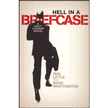
Hell In A Briefcase

HAPPY NEW YEAR!!! It is
January 1st, time for the FIRST Day Blog Tour! (Join our alliance!) The FIRST day of every month we will feature an author and their latest book's FIRST chapter!


This month's feature author is:
Phil Little with Brad Whittington and their
book: HELL IN A BRIEFCASE (A Matt Cooper Novel)

Win a copy of this book!! Leave a comment and on Friday I'll pick a winner!


ELEVEN BRIEFCASES AND ONE UNLIKELY HERO...CAN MATT COOPER FIND ELEVEN NUCLEAR DEVICES AND HIS FAITH BEFORE DISASTER STRIKES?

With violence in the Middle East escalating daily, Americans are glued to their televisions wondering what will happen next. Meanwhile, Matt Cooper, jet-setting star of Phil Little's debut novel Hell in a Briefcase is doing something about it. A private security executive, his adrenaline-junkie days consist of last-minute first-class overseas flights, Hollywood parties with his actress girlfriend, and direct calls from top CIA brass. A chance meeting with Mr. Roberts, “an old broken-down millionaire” and uncommon Christian, sends Cooper on a trip to Israel that will change his life. Matt goes behind the curtain of Middle East terrorism, witnessing firsthand the untold ravages of holy war. The deeper he goes, the closer he gets to a plot involving eleven stolen briefcase nukes and a plan infinitely more sinister than 9/11.

ABOUT THE AUTHOR:

Phil Little, president of West Coast Detectives and a recognized expert in counter-terrorism, provides bodyguards to the stars and runs a detective agency that has served ABC, NBC, CBS, CNN, FOX, Paramount, MGM, and hundreds of others (www.westcoastdetectives.us). He draws on this experience in crafting the tightly wound plot of this international thriller. In addition to his duties as a security expert, Phil has also written Hostile Intent, Protecting Yourself from Terrorism and will soon be the subject of a television pilot. In the meantime, you can read more about Matt's adventures in his blog, http://detectivemattcooper.blogspot.com.

In addition, Phil is available for comment on all aspects of international terrorism, both at home and abroad, and he makes for an interesting and colorful guest. His expertise in the area of international issues combined with his personable on-camera style would make for a great interview on this hot topic. From Lebanese terror camps in the 1970’s to American airports in the months before 9/11, Phil Little has witnessed the terror threat up close and can share eye-opening stories and information that all Americans should know.

THE FIRST CHAPTER:

Marjeyoun, Lebanon.

Thursday, 21 November 2002. 01:30.

A full moon. A glow seemed to rise from the sand, allowing them to drive with their headlights off. The five Jeeps kept to 40 kph on the dark road that wound southward between hills and wadis. In the third Jeep, Major Skaff allowed himself the brief luxury of picking out Pegasus in the sharp winter sky before he compulsively scanned the rocky terrain for signs of Hezbollah fedayeen. He was leading this patrol to check out rumors of increased activity near Shaaba Farms, the disputed area where three Israeli soldiers had been kidnapped two years before.

The ridge road ran from the town of Marjeyoun down to Qlaia’a under the ominous gaze of Shqif Arnoun-the castle called “Beaufort” by the Crusaders-to the west. Christians and Muslims had fought for this ground for centuries, trading possession of the castle as their fortunes rose and fell. In the 1970’s the Palestinian Liberation Organization had used the strategic placement of the castle to shell civilian settlements in northern Israel.

That was when Skaff, then a young recruit of the Southern Lebanese Army, had been a driver in a similar convoy, shortly before the civil war broke out between Christians and Muslims in 1975. Traversing this very ridge on a mission, he had come under fire from the castle. His evasive driving had saved the convoy and drawn the attention of General Lahd.

The intervening thirty years had been a generation of unremitting war. Israel, tiring of mounting civilian casualties and the Lebanese government’s refusal to expel the terrorists, invaded southern Lebanon in 1982 and captured the castle. Eighteen years of occupation followed, during which Skaff had risen through the SLA ranks while working openly with the Israelis to keep the various Muslim factions at bay. When he had started, Hezbollah did not exist. Now the radical Muslim army controlled the south and dealt severely with the Christian resistance.

As the occupation had grown increasingly costly and casualties mounted, the pressure increased for Israel to withdraw. When the SLA collapsed in 2000, Israel destroyed what was left of the castle walls and pulled back behind the Blue Line specified by the UN. The SLA scattered. Thousands fled to Israel or went into hiding. Those who didn’t were imprisoned and tried as enemy collaborators. As Hezbollah gained control of the area, the anticipated slaughter of Christians didn’t materialize. But any SLA militiamen emboldened to return were also imprisoned.

As he scanned the distant ruins of the castle in the moonlight, Major Skaff reflected on change and constancy. Where PLO guns had once rained death on Israel and Lebanese Christians, now tourists snapped pictures and rushed home to post them on the Internet. And the same General Antoine Lahd who had brought him up in the ranks and fought beside him for decades had fled to Paris. Only a week ago he had opened a fancy restaurant in Tel Aviv called Byblos. It had a nice ocean view.

True, Lahd had a death sentence hanging over him for treason and war crimes, but so did Skaff. And so did many of the two thousand SLA in Lebanese prisons.

But some things had not changed. Southern Lebanon was just as dangerous for the men in these Jeeps as it had been when Skaff was driving instead of commanding.

Skaff was drawn from his reflections by a dark shape ahead. At the end of the ridge the road snaked through an outcropping of rock. He had passed through it many times, always with reluctance. This night he felt a peculiar sense of revulsion as he squinted at the misshapen lump of stone looming before him.

He nudged his driver and nodded toward the rocks. Hassan nodded back. He could feel it too. Skaff reached for the radio to signal the lead Jeep. A lifetime of guerrilla fighting had convinced him that such premonitions were not without merit. His transmission was brief, but they were already entering the outcropping when he put the radio down.

Five seconds later a rocket hit the grille of the lead Jeep. The explosion lit the rocks towering over them. He saw the silhouettes of two men blow out on either side of the vehicle, which was tossed onto the nose of the next Jeep. Hassan narrowly missed them, skidding left and stopping next to the driver of the lead Jeep, who was lying half off the road.

The two Jeeps behind slid sideways to a stop in the road as machine gun bursts echoed from beyond the lead Jeep. Skaff was exposed to the attack. He dove from his seat to the rear of the second Jeep, between two men already returning fire with an Uzi and an M-16.

He rolled to his feet and yelled to the two back Jeeps, motioning for them to form a double barricade with their vehicles, keeping the men covered both in the front and the rear in case the attackers attempted to sandwich them in the gap. Skaff turned back, confident that his men needed no further direction. This mission called for battle-hardened veterans, and he had personally selected the nineteen men who were with him now. Every man among them had proved himself in years of combat. Some even owed their life to his cool command in battle. Some had returned the favor multiple times.

Skaff scanned the forward battle to account for the remaining eleven men, his position shielded by the lead Jeep transfixed on the grille of the second. To the left, Hassan was pulling the driver of the first Jeep to safety. The other two men from Skaff’s Jeep were covering him with sporadic fire from their Uzis. Ahead, the driver of the second Jeep was placing a case of grenades handy to his partner, who had fitted his M-16 with a grenade launcher and was set up in the backseat. Skaff was standing beside the other two passengers in the second Jeep. That left the three passengers from the lead Jeep.

He spotted Saif on the right. He had been thrown clear onto the sand without apparent injury. He was crouched behind a boulder, occasionally returning fire with his Desert Eagle .50-caliber side arm. Failing to sight the other two, he shouted to the driver, who had acquired an Uzi.

“Rafik? Sayyed?”

He nodded forward. Skaff crawled over the middle of the jeep to the hood. Sayyed was wedged between the lead Jeep and the grille of the second Jeep, most likely dead. Rafik was lying on the hood of the second Jeep. Skaff checked for a pulse. Nothing. He closed Rafik’s eyes and whispered a short prayer. Skaff couldn’t play favorites with his men, but this loss was harder than any other would have been. At nineteen, Rafik had already spent four years with Skaff, rarely more than fifty yards from his side. Four years of relentless, driven hate. Skaff had been Rafik’s ticket for revenge. Perhaps now he had found the peace revenge had not been able to bring him.

Skaff was crawling back to get a weapon when the second rocket hit the bottom of the lead Jeep. The gas tank exploded, sending most of the shrapnel back toward the attackers. The force of the blast threw the second Jeep back five feet, knocking over the two shooters behind. The grenade launcher and the man with it fell into the front seat. The driver was standing to the side. He returned fire with the Uzi.

Skaff helped reposition the grenade launcher and crawled out of the Jeep. The two in back were already firing again. He scanned the area and then dove toward the two Jeeps in the rear. Of the eight men between the jeeps, one had taken a round in the right shoulder but was still firing left-handed, propped against a door. Three were facing the rear but indicated they hadn’t seen any action, yet. Two were covering the walls on either side with M-16s, but also hadn’t seen action. The final two had grenade launchers on their M-16s. They waited until they saw several volleys of tracer bullets originating from a single location. Then they fired three seconds apart at the source. The machine gun fire stopped. Skaff slapped them on the back. Perhaps they would get out of this thing alive.

Then a rocket hit Skaff’s Jeep. Hassan was behind a curtain of stone, firing with an Uzi, having propped the injured driver in a cleft in the rock. But the other two were using the Jeep for cover. One tumbled backward, clear of the Jeep. The other was knocked down as the Jeep rolled over, pinning his leg under it. Skaff ran through a volley of automatic weapons fire and pulled the first man to his feet. They raced to the Jeep, joined by Hassan, and rocked it back over. Then they dragged the injured man to safety next to the injured driver.

Skaff felt a shudder of unease ripple through the adrenaline-laced focus that always came over him in combat. If this kept up, the whole team would be shredded before they had used half their ammo. He grabbed Hassan’s arm and yelled into his ear over the din.

“We have to take out that rocket launcher or we don’t get out of here. Take those three and circle around.” Hassan nodded and stepped away but Skaff grabbed his arm. “Take a radio.”

He let go, and Hassan ran to the rear while the others laid down covering fire. Skaff used the opportunity to race to the front two Jeeps and get the four there away from the vehicles and behind the cover of the rocks. As they ran for cover, another rocket hit the top of the lead Jeep, sending fragments of the grille and fenders flying in all directions. Skaff ran through the explosion back to the rock curtain. When he fell against a boulder the injured man pointed at Skaff’s leg. He looked down and saw that his left trouser leg was slashed in three places. Blood was seeping down to his boots. He looked around to see how the others had fared.

Saif seemed to have been hit in the arm by something. He was now firing the Eagle while holding his upper arm with the other hand. The other four seemed to have escaped unscathed. Skaff’s radio had not survived the rocket. He nodded to the man next to him, who wielded an Uzi while he made it to the two back Jeeps, getting an Uzi and a radio. He turned it up all the way and slung it over his shoulder. Then he began firing at the source of tracers beyond the rubble of the Jeeps.

Looking for some encouragement, Skaff probed his memory. In almost three decades of fighting, he didn’t recall anything quite as dire as the current circumstance. He had two confirmed dead, one unconscious, three wounded but still firing. Almost a third of the force. The numbers were bound to increase as long as that rocket launcher was working. His calculations were interrupted by Hassan’s voice squawking through the pandemonium.

“We got the rocket launcher, but I think they have another on the left. And now we’re pinned down, so we’re going nowhere.”

The last word was drowned out by a rocket blast on the rock curtain above the injured men. Skaff doubted he could get a team around the other side. Even if he did, the enemy would be expecting them. No way around. No way through. He scanned the sheer rock walls on either side. No way over. The fedayeen had chosen their positions well and appeared to have ample men, weapons, and ammo. It seemed likely that most of this team would share the fate of Rafik and Sayyed. Probably all. The thought sickened Skaff, turning the adrenaline in his veins to bile in his throat.

There was one last hope, but it might be too late. He selected another frequency on the radio and shouted over the gunfire, “Lehafil Levanon Sanctzia. Lehafil Levanon Sanctzia. (Activate Lebanon Sanction.)”

Friday, December 1, 2006

December FIRST


It is December 1st, time for the FIRST Day Blog Tour! (Join our alliance! Click the button!) The FIRST day of every month we will feature an author and their latest book's FIRST chapter!

This month's feature author is:


BRYAN DAVIS

and his latest book:

Eye of the Oracle


Bryan Davis is the author of the four book Dragons in Our Midst series, a contemporary/fantasy blend for young people. The first book, Raising Dragons, was released in July of 2004. The second book, The Candlestone, followed in October. Circles of Seven debuted in April of 2005, followed in November by Tears of a Dragon.

Bryan is the author of several other works including The Image of a Father (AMG) and Spit and Polish for Husbands (AMG), and four books in the Arch Books series: The Story of Jesus' Baptism and Temptation, The Day Jesus Died, The Story of the Empty Tomb (over 100,000 sold), and Jacob's Dream. Bryan lives in Winter Park, Florida with his wife, Susie, and their children. Bryan and Susie have homeschooled their four girls and three boys.

To read more about Bryan and his books, visit the
Dragons in our Midst Website or visit Bryan's blog.

Eye of the Oracle

by Bryan Davis


Dragons in our Midst - Prequel
Oracles of Fire - Volume 1


The Seeds of Eden


Angling into a plunging dive, the dragon blasted a fireball at Lilith and Naamah. The two women dropped to the ground just as the flaming sphere sizzled over their heads. Naamah swatted her hair, whipping away stinging sparks that rained down from the fireball's tail.


With a flurry of wings and a gust of wind, the dragon swooped low. As razor sharp claws jabbed at the women, Naamah lunged to the side, and Lilith rolled through the grass. A single claw caught Lilith's long black dress, ripping it as the dragon lifted toward the sky.


Naamah jumped to her feet and helped Lilith up. The dragon made a sharp turn in the air, and, with its jagged-toothed maw stretching open, charged back toward them.


Lilith pushed a trembling hand into the pocket of her dress. "Only one hope left," she said, panting. Pulling out a handful of black powder, she tossed it over her head. "Give me darkness!" she cried.


The powder spread out into a cloud and surrounded the women. Naamah coughed and spat. The noxious fumes blinded her and coated her throat with an acrid film. A hand grabbed her wrist and jerked her down to her knees just as another flaming cannon ball passed over their heads.


"Crawl!" Lilith ordered.


Naamah scooted alongside Lilith as she scuffled over the dry tufts of grass. Sparks from the rain of fire ignited tiny blazes that illuminated their hands as they passed through the veil of darkness.


Naamah gagged but refused to cough. With a guardian dragon hovering somewhere overhead, giving any clue to their whereabouts could be fatal.


After several minutes, Lilith whispered, "I think I found the cave."


Her hands, barely visible and clutching a small bundle of sticks, crawled over a bed of gravel and then to a rocky floor. When she finally stopped, Naamah sat up and gazed into the dark cloud behind her. She squeezed fractured words through her tingling throat. "Will the dragon follow?"


"Shachar is persistent," Lilith rasped, "but she is no fool." She coughed quietly, clearing her voice. "She will not risk the possibility that we're a diversion for a more dangerous attack. If she doesn't find us soon, she will go back on patrol."


"What about her dragon sense? Won't that draw her to us?"


"I'm not sure. A dragon's danger alarm is still a mystery to me. I think since our only direct threat is to the ancient garden she patrols, her sense of protection will draw her there."


The black cloud began to dissipate, revealing the mouth of a shallow cave, barely deep enough to keep out the wind. Close to the back wall, the women found a flat stone and built a fire next to it with Lilith's collection of sticks. When the crackling flames began to rise, Lilith and Naamah sat on the stone to rest.


From her pocket, Lilith withdrew a small bundle wrapped in a black cloth. After untying a knot on one end, she produced an earthenware cup filled with herbs. "The way to Eden has yet another obstacle," she said, tossing a pinch of the herbs into the campfire. "Our task will not be easy."


Sparks flew toward the cave's low ceiling, riding on thin strings of silvery-green smoke. Naamah breathed deeply of the aroma-saturated air, a pungent blend of camphor and garlic. She exhaled, tasting the herbs at the back of her tongue. "What could be more difficult than getting past a dragon?"


"There are forces in our world that dwarf the power of dragons. I have foreseen much that you don't know."


As cool, damp air chiseled away at the fire's rising warmth, Naamah scooted toward her sister, overlapping the fringes of their silky black dresses on the flat stone. Barefoot and shivering in the draft, she wrapped her arms around herself. "Didn't you know it would be this cold? We should have worn our cloaks."


"It is only temporary. The cold air is a path that leads us to the garden." Lilith pushed her long black hair off her shoulder and huddled close, her voice low. "Naamah, you must have more faith in me. My husband's arts have allowed me to see another world, the world of phantasmal knowledge. It is the realm of future possibilities, where I can see what might happen."


Naamah folded her hands. "What might happen?"


The bushes rustled just outside the entrance. Lilith glanced over her shoulder, her lips pressing into two pale lines as she set the cup of herbs on the cave's floor and drew a dagger from a sheath on her belt.


"Just the wind," Naamah whispered. "If it were the dragon, we would have heard her wings."


"Perhaps." Lilith's knuckles whitened as she wrung the dagger's wooden hilt. "But even the wind carries spirits who might expose our plans."


Naamah waited for the color to return to Lilith's fingers. "So ¡­ why are you counting on phantasmal knowledge when it can't tell you for sure what's going to happen?"


"Because our opponent is so predictable." Lilith placed her long, thin hand on Naamah's thigh. "Life is the ultimate game of chance, with millions of possible moves, so I only see what might happen. My choices and our opponent's choices mesh in a tapestry through time, and I can see where some of the threads lead if I follow one or more of the thousands of patterns that fill my eyes. So far, Elohim has reacted to my moves exactly as I expected he would."


Lilith waved the dagger over the fire. A bright, angelic creature swirled inside the rising smoke, its image warping and undulating as the draft swept it around. Inside the flames, a red dragon appeared, jets of fire blasting from its nostrils. The dragon's blaze licked at the angel's bare feet as it whipped around in the smoke's endless circles. "Our plans rest on Samyaza's shoulders, and if he fails, our doom is certain. We must prepare for that possibility."


Naamah rubbed her hands up and down her bare arms. "How can this husband of yours give you the power to see the future? I have never known a man who could see past a bottle ¡­ or a brothel."


"You have never known such a man, because you don't know the Watchers." She thrust the dagger back to its sheath. "Your men are all fools."


Naamah pulled the hem of her dress high above her knee. "Fools, yes, but their money spends as well as yours."


Lilith slapped Naamah's hand and yanked the skirt back down. "Your harlotry will be the death of you someday! Sister or not, I cannot protect you from yourself."


Naamah caressed her stinging hand and scowled. "You didn't call it harlotry back when we were collecting wild oats together. You've been no fun at all since you got religion with Samyaza."


Lilith grabbed Naamah's shoulder and pulled her almost nose to nose, hissing. "This religion, as you call it, might just save your life. If you want to survive, you had better listen to me!"


Read the rest of chapter one here

Wednesday, November 1, 2006

November FIRST


It is November 1st, time for the FIRST Day Blog Tour! (Join our alliance! Click the button!) The FIRST day of every month we will feature an author and their latest book's FIRST chapter!

This month's feature author is:

This blog is featuring a contest to win a copy of Nancy's new book, Coldwater Revival.

Just put in a comment and you
may be the winner! Contest will be open until Friday, I'll draw the winner on Saturday.


Just three weeks before her wedding, Emma Grace Falin has returned to her hometown of Coldwater, Texas, consumed by a single, burning desire. She must confront the guilt and shame of a devastating event that has haunted her since childhood.

"...What a stunning debut novel."
--Wendy Lawton, Literary Agent, author of Impressions in Clay

"An astonishing debut! Coldwater Revival is a hauntingly beautiful story made doubly so by Nancy Jo Jenkins stunning, lyrical writing. I was mesmerized from cover to cover."
--Deborah Raney, author of A Nest of Sparrows and A Vow to Cherish

AUTHOR INTERVIEW:
Meet Nancy Jo...

Q. How long did it take you to write Coldwater Revival?

A. I perceived the idea for Coldwater Revival in June, 2003, and completed the manuscript in March, 2005.

Q. Tell us about your journey from writer to published novelist.

A. During my teaching career, I dreamed of the day when I could write the stories that continually swam around in my head. I didn't know at the time that it would take me four or five years of attending workshops, conferences, retreats, lectures, and of studying tapes, books and other materials before I was ready to put my newly-acquired knowledge to use, and begin writing the stories that God had prompted me to write. In March, 2004, at the Mount Hermon Christian Writing Conference, I submitted a book proposal to Steve Laube (Literary agent), and Jeff Dunn, (Acquisitions Editor) for RiverOak. Both gentlemen asked me to send them all I had written on Coldwater Revival, which at the time was 109 pages. During the summer of 2004, both men offered me a contract. My book was published by RiverOak and released in May, 2006.

Q. The agony and healing Emma Grace went through are so real. What personal experiences did you draw from to portray Emma Grace's feelings so well?

A. There was a time in my life when I suffered with depression, though it was not due to a death in the family, as Emma Grace's was. At the time, it seemed that I was in a daily knock-down, drag-out fistfight with sadness. I was truly blessed in that I was never prescribed any kind of medication to treat my depression, which proved to be relatively short-lived. But I did receive counseling, which was just what I needed to win the battle with this debilitating condition. During that time of depression I endured many of the symptoms that Emma Grace suffered through. Excessive sleeping was about the only symptom we did not share. There were times when I couldn't swallow my food, and times when I could almost touch the face of that same blackness that almost overwhelmed Emma Grace. Her sorrow and guilt were difficult scenes for me to write, and I found myself crying each time I wrote about Emma Grace's sadness and the continual ache in her heart.

Q. Emma Grace loses all desire for life when her brother dies - not eating or talking, just living in the blissful cocoon of sleep. Do you have any advice for folks who are in that dark place right now?

A. Communication was the key that unlocked the door of depression for me. Communicate with God, even if the only words you can utter are the words, "Help me." But I also benefited greatly from talking to a certified counselor; one who was trained in helping people express their pain, their needs, their fears. I hope that anyone who feels sad and lonely for an extended length of time, will contact their pastor, or someone who can direct them to a Christian counselor.

Q. Emma Grace's grandmother lives in the city while the rest of the family lives in the country. Why do you think she didn't move out to the country with the rest of the family long ago?

A. Granny Falin immigrated from Ireland to America with her husband and son when Emma Grace's papa was just a lad. This family shared a dream about their new country. It would be a place where they could find work and prosperity, raise their family, and put down roots. Even the Great Hurricane of 1900 couldn't wash those dreams from Granny's heart. Though her only remaining child lived a hundred miles away in the rural township of Coldwater, Texas, Granny could never leave Galveston. The island and the sea that surrounded the island were her home now. It was where the ashes of her husband and three children were buried. It was the home she and her husband had dreamed of during their desperate years together in Ireland. If she left Galveston and moved to Roan's home, she would be giving up the dream she had shared with her husband.

Q. Papa and Elo have a tough time showing their emotions. Elo, especially, is so hard to read in the book. Why do you think some people hole up inside themselves rather than sharing their emotions?

A. I believe we are born with a portion of our personality already deeply embedded within us. Some people are reticent to express their feelings and emotions, while others have no problem whatsoever in expressing what they feel or think. I have known many individuals who are like Elo; people we sometimes refer to as "the strong, silent type". Papa and Elo are powerful protectors and providers who waste little time and effort on words. Both of these men feel that "actions speak louder than words". Added to that is the fact that Elo feels extreme discomfort when his mother and sisters are emotionally distraught, therefore, he maintains a rigid demeanor, in part, to provide a stable link in the chain that makes up his family - The Falins.

Q. Do you have other books coming out soon?

A. Thank you for asking about my upcoming books. I'm about to submit my proposal for a novel entitileld, "Whisper Mountain". This story takes place in the early 1900's in the Great Smoky Mountains. It is the story about lost love, and a desperate woman's journey to fill the void that deprivation and loss have left in her heart. The story has elements of mystery, intrigue, murder, and of course, romance. I'm very excited about this story. I've also begun writing a sequel to "Coldwater Revival" which will parallel both Emma Grace's life after 1933, and the adventurous trek Elo begins when he falls in love.


THE FIRST CHAPTER of
Coldwater Revival

One

Coldwater, Texas

Three weeks before I was to marry Gavin O'Donnell, I set my feet upon the beaten path leading to Two-Toe Creek. What I had to offer Gavin in marriage—my whole heart, or just a part—depended on the
decision I would make today.

As my feet tracked the dusty pathway they stirred loose soil to the air. My heart stirred as well, for the guilt I had buried in its depths smoldered as though my brother had just died, and not five years earlier. In the shadowed days following the tragedy, my disgrace had glared like a packet of shiny new buttons. I'd not thought to hide it at the time. In truth, I'd thought of little, other than how to survive. But at some point during that time of sorrowful existence, when my days and nights strung together like endless telegraph wires, I dug a trench around my heart and buried my shame.

From that day until this, I deeded myself the actor's role, closing the curtain on my stain of bitter memories, hiding my sorrow behind a veil of pretense. But that old deceiver, Time, had neither softened my guilt nor put it to rest; only allowed it ample pause to fester like deadly gangrene. Now, as the day of my wedding drew near, my heart cried out for healing. It was, you see, far wiser than my head. My heart understood its need for restoration—before I exchanged wedding vows with Gavin. For this reason, I now walked the trail to Two-Toe Creek. To revisit my failures of yesteryear and reclaim the peace that had slipped past the portals of my childhood. Perhaps then I could give Gavin the entirety of my heart.


Saturday, September 30, 2006


WIN A FREE COPY OF DARK HOUR!!!

Post a comment and I'll draw the winner on October 2, 2006

It is October 1st, time for the FIRST Day Blog Tour! (Join our alliance! Click the button!) The FIRST day of every month we will feature an author and their latest book's FIRST chapter!

This month's feature author is:
Ginger Garrett


About the author:
Ginger Garrett is an acclaimed novelist and expert in ancient women's history.Her first novel, Chosen, was recognized as one of the best five novels of the year by the Christian publishing industry. Ginger enjoys a diverse reader base and creates conversation between cultures.


In addition to her 2006 and 2007 novels about the most evil women in biblical history, she will release Beauty Secrets of the Bible (published by Thomas Nelson) in Summer 2007.


Ginger Garrett's Dark Hour delves into the biblical account of Jezebel's daughter and her attempt to end the line of David.


And now, a special Q&A with Ginger Garrett:

1.) First, tell us a bit about Dark Hour.

I was praying about what book to write after Chosen, and accidentally left my open Bible on the kitchen table. (A dangerous thing, since in my house, small children and large dogs routinely scavenge with dirty hands and noses for snacks!) As I walked past it, I saw a caption about someone named Athaliah and a mass murder. I stopped cold. I knew it was my story.


Athaliah was the daughter of Jezebel--a real woman in history--who tried to destroy all the descendents of King David in a massacre. God made a promise that a descendent of King David would always sit on the throne, and one day a Messiah would come from this line. If Athaliah succeeded, she would break the promise between God and the people, and destroy all hope for a Messiah.One woman, her step-daughter, Jehoshebeth, defied her. She stole a baby during the massacre and hid him. Between them, the two women literally fought for the fate of the world.

2.) What drew you to write biblical fiction?

The similarities between the lives of ancient women and our lives. We get distracted by their "packaging," the way they dressed and lived, but at heart, our stories are parallel.

3.) How much time is spent researching the novel versus writing the novel?

Equal amounts, and I don't stop researching while I write. I have a historical expert, probably the best in the world in his field, review the manuscript and point out errors. The tough part is deciding when to ignore his advice. He pointed out that most everyone rode donkeys if they weren't in the military, but a key scene in the novel involves riding a horse to the rescue. It would have been anti-climatic to charge in on a donkey! :) So I ignored his advice on that one.

4.) Dark Hour takes its reader deep into the heart of palace intrigue and betrayals. Were parts of this book difficult to write?

I left out much of the darkest material I uncovered in research. It was important to show how violent and treacherous these times and this woman (Athaliah) could be, but I tried to be cautious about how to do it. The story was so powerful and hopeful--how one woman's courage in the face of evil saved the world--but the evil was depressing. I tried to move quickly past it. I wanted balance. Our heroine suffers and some wounds are not completely healed in her lifetime. That's true for us, too.

5.) What would modern readers find surprising about ancient women?

They had a powerful sense of the community of women. They also wore make-up: blush, glitter eyeshadow, lipstick, powder, and perfume! They drank beer with straws, and enjoyed "Fritos": ground grains, fried and salted. Many of our foods are the same today, but they loved to serve pate made from dried locusts, finely ground. Ugh!


Without further ado...here is the FIRST chapter of Dark Hour by Ginger Garrett. Judge for yourself if you'd like to read more!


(There is a prologue before chapter one regarding the birth of Jehoshebeth... Athaliah is not Jehoshebeth's biological mother.)


c h a p t e r O n e


Fifteen Years Later


HER BARU, the priest of divination, opened the goatskin bag and spread the wet liver along the floor, leaving a path of blood as he worked. Retrieving a wooden board and pegs from his other satchel, the satchel that held the knives and charms, he placed pegs in the board according to where the liver was marked by fat and disease. He turned the black liver over, revealing a ragged abscess.


Athaliah covered her mouth and nose with her hands to ward off the smell but would not turn way.


“Worms,” her sorcerer said, not looking up. He placed more pegs in the board before he stopped, and his breath caught.


A freezing wind touched them, though they were in the heart of the palace in the heat of the afternoon. Athaliah cursed this cold thing that had found her again and watched the sorcerer search for the source of the chill before he returned to the divination. There was no source of wind here; in her chamber there was a bed, the table where her servants applied her cosmetics from ornate and lovely jars shaped like animals, a limestone toilet, and in the farthest corner so that no one at the chamber door would see it, her shrine. Statues of Baal, the storm god, and the great goddess Asherah, who called all life into being, stood among the panting lions carved from ivory and the oil lamps that burned at all hours. Here she placed her offerings of incense and oil, and here she whispered to the icy thing as it worshiped alongside her.


The baru watched as the flames in the shrine swayed, the chill moving among the gods. The flames stayed at an angle until one began to burn the face of Asherah. Her painted face began to melt, first her eyes running black and then her mouth flowing red. He gasped and stood.


“I must return to the city.”


Athaliah stood, blocking him from his satchel.


“What does the liver say?”


“It is not good that I have come. We will work another day.”


She did not move. He glanced at the door. Guards with sharp swords were posted outside.


“A dead king still rules here. You set yourself against him
and are damned.”


Athaliah sighed. “You speak of David.”


The baru nodded and bent closer so no other thing would hear his whisper. “There is a prophecy about him, that one from the house of David will always reign in Judah. His light will never die.”


“I fear no man, dead or living.”


The baru continued to whisper, fear pushing into his eyes, making them wide. “It is not the man you must fear. It is his God.”


Athaliah bit her lip and considered his words. She wished he didn’t tremble. It was such a burden to comfort a man.


“Yes, this God. It is this God who troubles us. Perhaps I can make an offering to Him. You must instruct me. Stay, my friend, stay.” She patted him on the arm, detesting his clammy flesh. “I have dreamed,” she confessed. “I have a message from this God, and I must know how to answer Him.”


The baru took a step back, shaking his head. “What is this dream?”


“A man,” Athaliah said.


“Tell me.”


“At night, when I sleep and the moon blankets my chamber, I see a man. He is not as we are: he is coarse and wild. He wears skins hewn from savage beasts, run round his waist with careless thought, and in his mind he is always running, ax in hand, running. I feel his thoughts, his mind churning with unrest, and he knows mine completely. I hear a burning whisper from heaven and shut up my ears, but he turns to the sound. A great hand touches him, sealing him for what lies ahead, and speaks a name I cannot hear, a calling to one yet to be. I try to strike this man, but all goes red, blankets of red washing down.”


She licked her lips and waited, breathing hard. The baru nodded.


“You see the prophet of Yahweh, Elijah, who plagues your mother.”


The baru began to reach for his goatskin sack. He picked up the liver and put it in the sack, keeping an eye on the door as he wiped his bloody hand on his robes. She knew he was measuring his steps in his mind, thinking only of freedom from here, and from her.


Athaliah grabbed his arm. “I let those who worship Yahweh
live in peace. They mean nothing to me; what is one God in a
land of so many? Why would this God send a man to make war
on my mother and then claim me also?”


The baru narrowed his eyes. “This God is not like the others.”


“How can we be free of Him?”


The baru thought for a moment then reached into his satchel. He pulled out a handful of teeth and tossed them on the ground at her feet. She did not move.


He squatted and read them, probing them with a shaking finger. She watched as the hair along his neck rose, and goose bumps popped all along his skin. The cold thing had wrapped itself tightly around him. She could see his breath.


“There is a child,” he said. “The eye of Yahweh is upon this child, always. I must counsel you to find this child and kill it, for when it is gone, Yahweh would trouble you no more.”


Athaliah murmured and ran her teeth over her lips, biting and dragging the skin as her thoughts worked back in time. “It is my daughter you speak of. Only a girl. But even so, I cannot kill her yet. I would lose my rights as the most favored wife. I will not risk my crown for so small a prize. No, I will find another way to get rid of her, and I will deal with this threat from Yahweh as I must.”


Athaliah walked to her shrine and cleaned the face of Asherah. She could hear the baru scooping the teeth back into the bag. She turned with a sly smile, pleased that her mind worked so quickly even with the cold thing so near.


“My mother has already angered this God. We will let her have our problem. She has a talent for these things.”


He had finished putting everything back into his two sacks and edged toward the door. She wondered if he would return. He was the best she had at divining dreams and saw in the liver so many answers. She sighed and tried to think of a word to reassure him.


“A farmer may own the field,” she began, “but much work is done before a harvest is even planted. Stones are removed, weeds are torn free. We must break loose the soil and uproot our enemies so the field will be ready. On that day I will sow richly.”


He managed a weak smile.


“Let your appetite grow, my friend,” she coaxed. “The harvest is coming.”


He fled so quickly she knew her words had been wasted, as all words were on frightened men. He would never return.


***

PRINCE JEHORAM nursed a silver bowl of dark wine and wished the business of inheriting a kingdom did not involve so much listening. He rubbed his beard, its thick clinging brown curls now flecked with gray. His beard was weathering his age better than the hair on his head, he realized, which had already surrendered to the assault of time, great gray streaks overtaking the brown. He knew his face was kind, though, not hardened or roughened by his years, but retaining a boyish appeal in his wry mouth and a small scar just under his left eye. Any woman could look upon him and see the child of mischief he once was. All women looked upon him and still thought to correct him.


He dined in a dim, private room with his advisers. The room was adjacent to the throne room, where he would one day rule, and was bare, save for an oil lamp on a low table. Cedar beams topped the limestone walls, giving the palace a sweet, smoky scent under the afternoon sun. The men sat around the table, scattered with maps, sharing a lunch of grapes, bread, wine, and cheese. Normally they would eat more, and in the dining hall, but the kitchen servants were busy preparing for the great send-off feast and it was easier to be served here.


Tomorrow, his father, King Jehoshaphat, would lead Judah’s army north toward Israel and King Ahab. Together, the two kingdoms would fight their inconstant friend Ben-Hadad to end his trade monopolies. Ben-Hadad fought alongside them against the cruel Assyrians but turned often and claimed the richest of trade cities for himself.


“There are implications, my prince,” Ethan said. Ethan was the tallest, and his skin turned red when he was angry, which was often. His temper had plagued him since he and the prince were boys, but now Jehoram no longer found pleasure in goading his friend. “If the kings succeed at Ramoth-Gilead against Ben-Hadad,” Ethan continued, “and the proposed alliance is
accepted, your father will have obligations both to the north and south. In this way, Ahab’s kingdom will be strengthened by this victory, and your own kingdom will be compromised. Judah may weaken and fall at last to a king of Israel.”


“I have married the daughter of Ahab,” Jehoram replied. “I have given their daughter an heir and promised her the crown. I have curried the favor of the north well enough. They will not turn on me, for their own daughter is at my side.” He tried to entertain himself with the food and wine while his advisers prattled on. He wondered what would be served at the feast tonight. If the servants’ exhausted expressions were any indication, the spread would be remarkable.


“That is true, my friend,” Ethan said. “But you are wrong to think this is Ahab’s war. It is a woman who is shaping this new world. Think on this: What does the powerful Jezebel desire more than to bring glory to her own name? She wants the north and south reunited so that she may one day rule them both, a queen equal in power to Solomon.”


Ethan smirked as he continued. “Everyone knows Ahab wears the crown but Jezebel rules. With Ahab and Jehoshaphat together in battle, their voices silenced for a time, Jezebel will be listening for yours. Let her know a lion roars in Judah. We will never be ruled by a woman, especially one who hides behind her husband’s crown.”


Jehoram listened, running his tongue across his lips, catching a spot of wine resting just above his lip. Ethan was his truest friend, if a man about to wear the crown had one, but he was always ready for a fight. Jehoram preferred to suffer a blow and stay with his women and wine. He sighed. “Ethan, you look into darkness and see monsters, but I see only shadows. It has always been this way.”


Ethan frowned. “We are no longer children hunting with our fathers at night. Listen to me, for I am the voice of God in your ear.”


Jehoram turned his face away and crossed his arms. Then he sighed and reached for a bowl of grapes and began to eat. He did not like an empty stomach.


Another adviser bit into some cheese and leaned in. “Mighty Ethan is right. Jezebel wants to see you on the throne because of your union with her daughter Athaliah, but she is no ally. Listen to what I tell you: Something evil here stirs the water and watches.”


“These voices of doom!” Jehoram yelled, slapping his bowl down on the table so that it spilled. “These voices and whispers, will they not cease?” He gripped his head and glared at the men. Each had but one wife and thought to advise him on his many? “You warn me against women, even my own wife, but they are women and nothing more!”


Ethan scooted closer to him. “Do not play the fool. Athaliah practices her strange magic and you slip under her spell little by little. There is still time to save yourself, and the kingdom, if you are indeed a man and king.”


Jehoram rose and adjusted his robe around his shoulders, staring down at Ethan.


“Do even my friends turn against me now?” he asked.


“I have always been like a brother to you. I desire nothing but your good,” Ethan said, rising. Jehoram held his temper and the two men glared at each other, breathing hard.


The adviser Ornat spoke. “May I address the future king of Judah?”


Jehoram nodded and sat, returning to his grapes. He glanced at Ethan and shook his head.


Ornat was new to his inner circle, an adviser Athaliah had recommended for his influence among the people who did not worship the God of Judah. She promised his voice would balance the harsh messages the others always gave. He had long, straight gray hair that always hung as if he had just come in from the rain. A magnificent bump crowned his nose, but it was the only remarkable feature about the man, a man who looked as if he were melting before their eyes.


“Good Jehoram,” Ornat began, “the king knows you are a son who is not like the father. King Jehoshaphat has conspired with your brothers to ensure you never take the throne. They plot behind closed doors, taking their meals without you. I have heard the plans from my spies among the servants.”


Jehoram felt his stomach churn at the accusation. He would not allow such ridiculous talk and raised his hand to dismiss the man at once.


The arrival of Athaliah interrupted them, and all bowed as she entered.


“Jehoram, I seek your face with a burden on my heart. Hear me and help me, my lord and husband,” she said.


Jehoram looked at her a moment, his eyes having trouble adjusting to the light that streamed in when the door had opened. She stirred something in him, as she had from her first night in the palace, rain-soaked and announced by thunder, her sheer robes clinging to her tiny frame. She came bearing boxes of shrines and gods, like the dolls of a child, and she clung to them even in their bedchamber. She was the only wife who did not submit to his will, and he had found her exotic. Now she had grown, but his exotic pet was still wild, shaking off the customs and manners he tried to teach her. He knew she hungered, but not for him. His face burned with shame.


“Speak, Athaliah,” he said.


“Your daughter has grown quite pale of late. I have seen this sickness before.”


Jehoram sat up straight. Sickness in the palace would spread
rapidly, a threat as swift and fierce as any Assyrian.


“What sickness?” he demanded.


Athaliah smiled at him, then at the men reclining.


“Of course you do not understand,” she said. “You are men. You have tended your kingdom well but neglected to see that your daughter has come of age.”


Jehoram exhaled and sat back, an indulgent smile on his lips.


“And what remedy does this sickness crave?” he asked.


Athaliah bowed before Jehoram. “She must marry, my lord.”


Jehoram waved his hand, a broad gesture. Here he could be master.


“I command, then, that she be married. If there is a commander well thought of, it would be an honor to give a daughter in marriage just before a battle.”


Athaliah nodded, just once. He felt his victory slipping away.


“I have sent word to the north,” Athaliah said, “to my mother’s house, that a nobleman from my own home who serves in the ivory palace of my mother be given her. King Ahab has sent you his favorite daughter.” She smiled. “Now let us send ours to him. It will be good for Jehoshebeth to hold your name ever before my father, Ahab. And Jezebel would relish a granddaughter so near.”


Jehoram stopped and frowned. “It is Jehoshebeth you speak of? She is a special child to me. I would not have her sent north.”


“But you have given the order that she be married. There is no one else worthy of her,” Athaliah said.


Jehoram rubbed his chin and pretended to study a map. Finally, he shook his head. “I must think on this.”


Athaliah bowed low, her eyes closed. “May the God you serve bless all your decisions, good Jehoram,” she said. She straightened and looked at the advisers. Jehoram could not bear to see their eyes upon his bride, the only territory he owned and could not rule. He detected secrets moving between her and Ornat like a sudden spring bubbling up from a dark source. Only a few found it distasteful and turned away. Ethan was the first to scowl and return his glance to the prince.


“I will see you all at the feast tonight,” Athaliah said as she left.
She wagged a finger at Ornat. “Take care of my good husband.”


Jehoram slouched in his seat and returned to his grapes.